What I Learned at IndustriaTech+AI: Cybersecurity, AI, and the Future of Industry
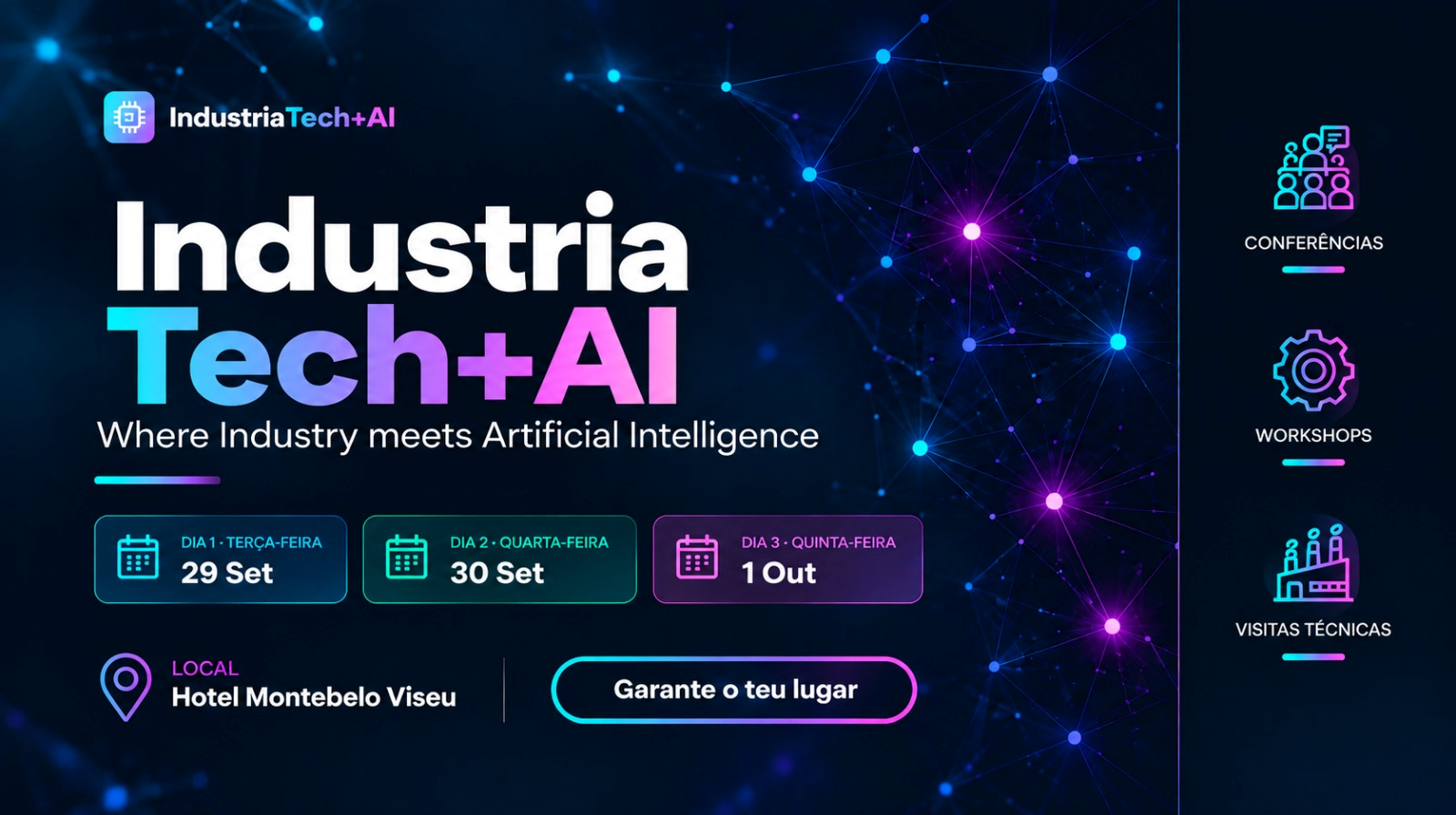
On September 29, I attended IndustriaTech+AI in Viseu. Between cybersecurity, artificial intelligence, industry, and startups, I left the conference with a new perspective on how these technologies are transforming the professional landscape.
 Diogo Peres· 9 min
On this page
On September 29, I had the opportunity to participate in IndustriaTech+AI, in Viseu.
Although the conference covered diverse tracks related to technology, industry, and artificial intelligence, from the start I decided to focus on the room dedicated to cybersecurity.
It was a natural choice.
As a student and software developer, I am increasingly interested not just in building applications, but in understanding what happens around them: how they are safeguarded, how they can be exploited, how AI is altering the threat landscape, and what challenges organizations will face in the coming years.
Throughout the day, across talks, workshops, and startup showcases, one central takeaway stayed with me:
Technology is evolving at a breakneck pace, but the capability to deploy it securely, responsibly, and strategically is becoming equally critical.
1. Artificial Intelligence Has Also Transformed the Cybersecurity Landscape
The first panel I attended focused on:
“Technology & AI and the current cyberthreat landscape”
The panel gathered diverse viewpoints on the intersection between technology, artificial intelligence, and the current cyber threat horizon.
The sessions touched on varied topics, ranging from managing human and non-human identities to the malicious weaponization of AI by cyber threat groups.
Management of Human and Non-Human Entities
The opening keynote was delivered by Ricardo Martins from CLOUDCOMPUTING, addressing the management of human and non-human entities.
This topic resonated deeply regarding modern system architecture.
For a long time, when we considered application users, we thought primarily about humans.
Today, that model is no longer sufficient.
We have microservices, APIs, automated background workers, IoT devices, software agents, and integrations that also require explicit identities, granular permissions, and strict audit controls.
Access management is no longer merely:
“Who is the user?”
It also demands answers to:
“Which system is making this request?”
“What permissions does it hold?”
“Why does it require them?”
This perspective is crucial now that autonomous systems and AI agents actively interact with enterprise databases and production APIs.
2. When AI Stops Being Just a Developer Tool
One of the most eye-opening talks was:
“The current landscape of malicious use of AI solutions by major cyberthreat clusters”, delivered by a representative of the Portuguese Republic Intelligence Service (SIS).
Artificial intelligence is often framed as a productivity multiplier.
We leverage AI to scaffold code, process unstructured documentation, synthesize insights, or automate repetitive tasks.
Yet there is inevitably a flip side.
The exact same technology can be leveraged by threat actors.
This necessitates a fundamental shift in how we approach AI.
We cannot solely ask:
“How can I leverage this technology?”
We must also proactively ask:
“How could this technology be weaponized against me or against the systems I design and deploy?”
This mental pivot is vital for software engineers.
An application might be fully functional and satisfy every user story in the backlog.
That alone does not guarantee resilience in an adversarial production environment.
3. Pentesting Is Entering a New Era
Another presentation that caught my attention was:
“Ethiack | Continuous Adversarial Exposure & Agentic AI Pentesting”, presented by André Baptista from Ethiack.
Employing artificial intelligence and autonomous agentic workflows to augment penetration testing represents a significant evolution in offensive and defensive security.
Historically, security testing was often treated as a staged milestone:
Development
     ↓
Testing
     ↓
Audit
     ↓
Production
However, as systems grow more distributed and threats emerge continuously, real-time posture awareness becomes paramount.
Instead of asking periodically:
“Is our application secure?”
The real question becomes:
“Do we remain secure against the latest active threats right now?”
This distinction may sound subtle, but it represents an essential shift toward continuous validation and adaptive defense.
4. From Prediction to Deterministic Execution
The concluding keynote of the first panel was:
“Sentinel.AI | From predictive insight to controlled, deterministic execution (AI-Powered Intelligence)”, presented by Amélia Moreira from Sentinel.AI.
This brought another valuable perspective: generating intelligence or predictive forecasts is only half the battle.
The real challenge is translating that intelligence into controlled, deterministic, and dependable actions.
This is especially critical when AI operates in mission-critical environments.
The more autonomy we grant an automated system, the stricter the guardrails must be.
Recommending an action is one thing.
Authorizing an autonomous agent to execute that action against production infrastructure is an entirely different league.
This reinforced a guiding principle:
The greater the autonomy granted to an AI system, the more rigorous our governance, monitoring, and deterministic constraints must be.
5. Cybersecurity Is Not Just a Technical Problem
The second panel covered:
“Cybersecurity in industrial organizations - Regulation and compliance”
Here, the discussion broadened to security in industrial ecosystems and enterprise environments.
Industry leaders shared practical perspectives:
- Cybersecurity in the space industry — Francisco Vilhena da Cunha, GeoSAT
- Paulo Vieira, Netskope
- Hugo Gonçalves, The Navigator Company
- Pedro Cordeiro, Critical Software
A key takeaway was the truly holistic scope of modern security.
It is never just about servers, firewalls, or codebases.
It encompasses corporate culture, supply chains, regulatory frameworks (such as NIS2), disaster recovery, human factors, and critical operational technologies.
A security breach is rarely confined to the IT department.
It rapidly cascades into an operational outage, financial loss, or existential brand crisis.
6. Modern Industry Is Increasingly Software-Dependent
This was one of the clearest takeaways of the day.
Modern manufacturing and industry rely on digital infrastructure at every stage:
Production
    ↓
Automation
    ↓
Sensors
    ↓
Data
    ↓
Cloud
    ↓
AI
    ↓
ERP & Management
Every layer of digitization expands the attack surface that must be monitored and defended.
This creates a dual reality:
Technology drives unprecedented efficiency, but simultaneously introduces new operational risks.
Therefore, technological innovation and defensive engineering cannot exist in silos.
They must evolve in lockstep.
7. The Workshop That Showed Me Another Side of Tech
Beyond the main stages, there were interactive workshops and founder discussions.
One of the standout sessions was:
“Zero Connections, Zero Venture Capital, Four Global Programs”
Presented by Kirk Patrick, Founder & Chief Architect at Arsia Labs.
The journey shared was inspiring.
Two founders based in Viseu, without venture capital backing, without an established political network, and outside major metropolitan hubs, successfully gained entry into premier global startup acceleration ecosystems, including:
- NVIDIA Inception
- Cloudflare for Startups
- Atlassian for Startups
- OVHcloud Startup Program
- Startup Portugal
- EU AI Pact
- Web Summit
Beyond the logos, the core lesson was clear:
Geographic location can be a constraint, but it is never a verdict.
Today, a focused, resourceful team—regardless of where they are based—can build software that competes on a global stage.
What matters most is the substance of what you build, the depth of the problem you solve, and your ability to execute consistently.
8. Startups Approaching AI with Real Utility
During the event, I had the chance to interact with founders leveraging artificial intelligence to solve concrete operational problems.
Among the solutions showcased:
- Industrial process automation;
- Real-time security and anomaly detection;
- Biometric authentication and analysis;
- AI-assisted legal copilots for contract analysis;
- Intelligent reservation and customer support automation for hospitality;
- Hardware-integrated safety monitoring.
What stood out was that these teams were not adopting AI simply because “AI is trending”.
They were deploying it where traditional algorithmic methods fell short.
That distinction is paramount.
9. AI Is Not the Product. It Is an Enabler.
This was perhaps the most grounding lesson from the startup sessions.
It is tempting to think:
“I want to build an AI app.”
That is rarely a viable product strategy on its own.
A much stronger question to ask is:
“What existing bottleneck costs organizations time, money, or cognitive bandwidth—and can intelligent automation solve it better than alternative approaches?”
The difference between those two mindsets is immense.
Great products do not originate from novelty tech stacks.
They start with a validated problem.
Only once the problem is understood do we select the right architectural tools.
That might be machine learning.
It might be deterministic automation.
It might be an event-driven webhook.
It might be a fast web interface.
Or it might simply be a well-indexed relational database.
10. What This Means for My Path as a Developer
As an aspiring software engineer, the conference pushed me to think far beyond daily syntax.
Much of my focus has naturally revolved around modern fullstack development: React, Node.js, relational databases, REST APIs, state management, mobile applications, and cloud deployments.
Yet events like IndustriaTech+AI underscore that software does not live in a vacuum.
Code runs within dynamic cloud infrastructure.
It is operated by real users.
It communicates with untrusted external services.
It persists sensitive data.
It is exposed to bad actors.
And increasingly, it interacts with AI subsystems to automate decisions.
A competent developer cannot merely ask:
“Can I make this feature work?”
We must routinely evaluate:
- Is it secure by default?
- Is it resilient and scalable?
- What telemetry and audit trails exist?
- Who has access to this data?
- How could this endpoint be abused?
- How does the system fail gracefully?
- What happens when latency spikes in production?
- Does AI genuinely add value here, or does it add unnecessary complexity?
11. A More Holistic View of Technology
I walked out of IndustriaTech+AI with a much broader perspective.
I walked in primarily curious about cybersecurity.
I walked out reflecting on the intertwined realities of AI, cloud architectures, industrial resilience, compliance, product discovery, and startup execution.
And that convergence was the highlight of the experience.
These domains do not exist in isolation.
They are deeply connected.
              Artificial Intelligence
                         │
          ┌──────────────┼──────────────┐
          ↓              ↓              ↓
    Cybersecurity     Industry      Automation
          │              │              │
          └──────────────┼──────────────┘
                         ↓
                      Software
                         ↓
                       People
As the technology landscape becomes more complex, the industry needs engineers who can bridge these disciplines with clarity and rigor.
Conclusion
Attending IndustriaTech+AI in Viseu provided a firsthand look at how emerging technologies are applied across competitive industries.
Cybersecurity demonstrated that building features that function is only the starting point; designing systems that withstand compromise is the true requirement.
AI showed that training models or calling APIs is trivial compared to delivering measurable utility.
And the startup founders proved that high-impact software can be built from anywhere with dedication and focus.
One summary captures the day:
Technology is simply a tool. The genuine value lies in the clarity of what we build with it and the real-world problems we resolve.
As a software developer, that is the most exciting realization of all.
There is still so much to learn and build.
Have an idea or opportunity to share?
Let’s talk